Barre vs Pilates
Barre vs Pilates
Barre builds muscular endurance through rhythm: small, repeated movements, high repetitions and a steady beat that keeps the muscles under tension until they shake. Pilates builds strength through precision: slower, controlled movement organized around the core, the breath and alignment. Both are low impact, and the right choice comes down to how you like to work.
Bare Wellness teaches both. The studio opens soon inside Bloom Arjaan by Rotana on Saadiyat Island, with barre and mat Pilates in the Open Studio and a dedicated ten-bed Reformer Studio next door. This guide compares the two practices honestly, so you can book the class that fits your goals rather than guessing.
At a glance
The difference at a glance
Rhythm vs precision
Barre works to a beat with small pulses and high repetitions. Pilates moves slowly, with every repetition controlled from the core.
Both low impact
Neither practice loads the joints with jumping or heavy weights, so both suit people managing impact, returning from a break or training on rest days.
Different kind of burn
Barre chases the shake: light resistance held until muscles fatigue. Pilates builds deep, stabilizing strength you feel the next day more than in the moment.
They combine well
The practices complement each other. Barre adds endurance and rhythm to the precision Pilates builds, and many members alternate them across the week.
How each class feels
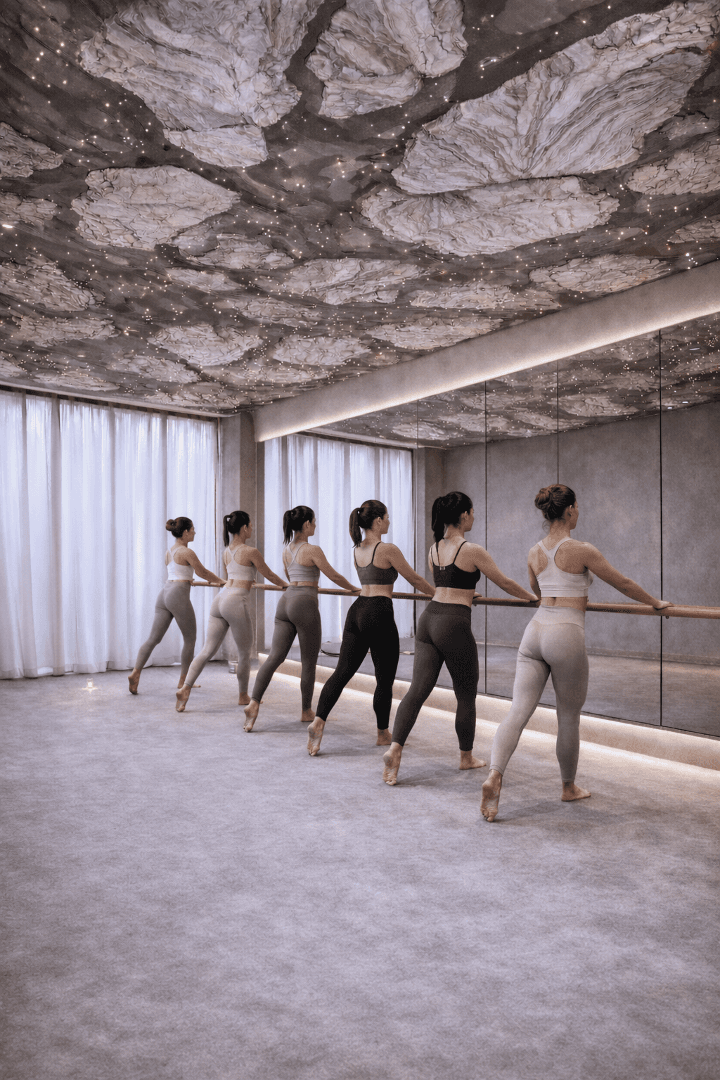
Barre borrows its shape from ballet conditioning, though you need no dance background. You work at the barre and in the center of the room through small, repeated movements, often just an inch or two of range, set to a rhythm. Light props raise the burn. The signature sensation is the shake, when a muscle held under tension finally starts to fatigue.
Pilates feels quieter and more deliberate. Every exercise is organized around the core, and the work is in doing less, better: slower tempo, exact positions, breath matched to movement. On the mat that means bodyweight control. On the reformer, spring resistance both supports and challenges you, and the carriage tells you the moment your alignment drifts.
Which builds more strength?
They build different kinds. Barre trains muscular endurance, the ability to keep working under light load for a long time, especially through the legs, glutes and shoulders. High repetitions and isometric holds teach muscles to resist fatigue, which carries over to running, long walks and anything rhythmic.
Pilates trains control: the deep core, the stabilizers around the hips and shoulders, and the postural muscles that hold everything in line. On the reformer, springs add real resistance through full ranges of movement, which is why reformer Pilates is where most people feel measurable strength change first. Neither replaces heavy lifting, and neither is trying to.
Which is better for beginners?
Both are beginner friendly in different ways. Barre asks for no technique before you start: the moves are small, the rhythm carries you, and you can drop out of a pulse whenever you need. It is a forgiving way to build fitness before adding anything more technical.
Pilates rewards patience early on. There is more to learn, breath patterns, neutral spine, how to find the core, but that teaching is the point, and it changes how you move everywhere else. A foundations class in mat Pilates is a calm place to start, and the reformer is more supportive than it looks.
How to choose for your goal
Most goals point clearly to one practice first. Use this as a starting point, then let how the class feels make the final call. If a goal matters enough to train for, it usually benefits from both practices across the week.
The list below is a shorthand, not a rule. Posture and back comfort tend to respond fastest to the precision work in Pilates, while stamina and tone respond to barre's repetition. If you have an injury or a medical condition, speak to your doctor first and flag it in your profile so instructors can support you.
- Core strength and posture: start with Pilates.
- Muscular endurance and tone: start with barre.
- Low impact cross-training for running or padel: alternate the two.
- A moving meditation with structure: Pilates on the reformer.
- Energy and rhythm at the end of the day: barre.
Barre and Pilates at Bare Wellness
At Bare Wellness the two practices live side by side. Barre and mat Pilates run in the Open Studio, and reformer classes run next door in a dedicated Reformer Studio with ten beds, so an instructor can watch every carriage. The timetable runs more than sixty classes a week at opening, across mornings, evenings and weekends.
The studio sits inside Bloom Arjaan by Rotana on Saadiyat Island, minutes from Mamsha Al Saadiyat, the Louvre Abu Dhabi and NYU Abu Dhabi, and a short drive from central Abu Dhabi over the Sheikh Khalifa Bridge. Every class books through the website or the iOS app, and cancellation is free up to six hours before class starts.
Good to know
Frequently asked
- Is barre harder than Pilates?
- They are hard in different ways. Barre burns in the moment, with light loads held until muscles shake. Pilates asks for concentration and control, and the effort often shows up as deep muscle fatigue the next day. Most people find whichever practice is newer to them harder.
- Is barre a type of Pilates?
- No, though they are related. Barre grew out of ballet conditioning and borrows core control ideas from Pilates, but it is its own practice: rhythmic, high repetition and endurance focused, where Pilates is slower and organized around precision.
- Which burns more calories, barre or Pilates?
- Usually they are close, and neither is primarily a calorie workout. Barre's continuous rhythm can feel more cardiovascular, while reformer Pilates can be surprisingly demanding under heavier springs. Consistency across the week matters far more than the difference between any two single classes.
- Can I do barre and Pilates in the same week?
- Yes, they pair well. Both are low impact, so recovery demands are modest, and the endurance from barre complements the control from Pilates. A common rhythm is two to three classes a week split between the two, adjusted to how your body responds.
- Do I need dance experience for barre?
- No. Barre borrows positions and vocabulary from ballet, but classes are conditioning, not choreography. If you can hold a squat and follow a beat, you can follow a barre class, and instructors offer options for every level.
- Does Bare Wellness teach both barre and Pilates?
- Yes. Barre and mat Pilates run in the Open Studio, and reformer Pilates runs in a dedicated ten-reformer studio. The studio opens soon inside Bloom Arjaan by Rotana on Saadiyat Island with more than sixty classes a week.
Keep reading
Saadiyat Island, Abu Dhabi
Begin your Bare ritual.
We open soon. Founding memberships are open by invitation: leave your details and your invitation opens straight away.