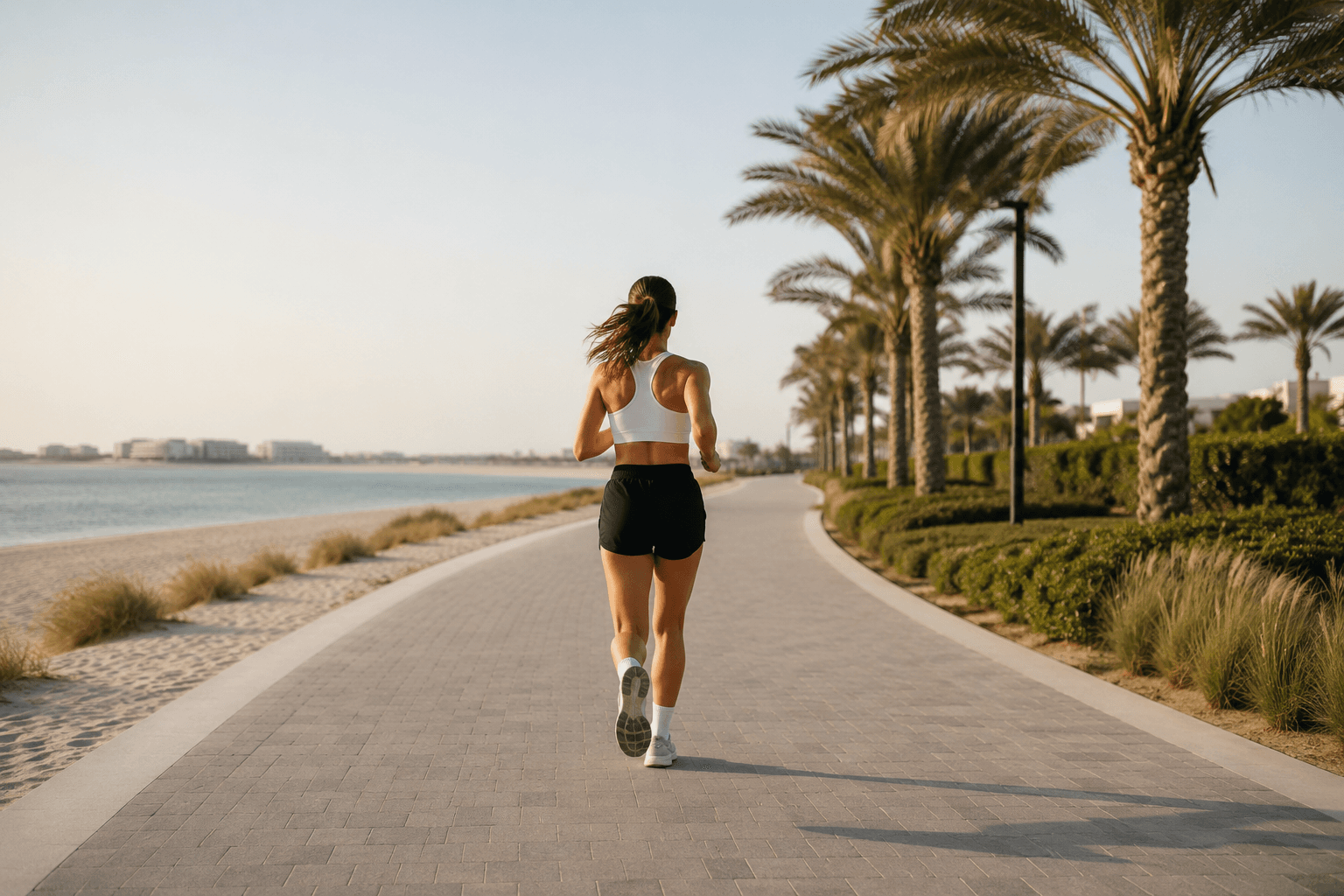
— For athletes
Pilates for athletes
Pilates is one of the most useful forms of cross-training an athlete can add, because it trains what most sport programs skip: deep core control, rotation and anti-rotation strength, mobility you can use under load, and better breathing mechanics. It builds the stability that lets you produce and absorb force efficiently, and it asks little of joints already carrying a heavy training week.
Bare Wellness opens on Saadiyat Island in Q3 2026 with two rooms built for exactly this kind of work: an Open Studio for mat, barre and hot classes, and a Reformer Studio with ten reformers where spring resistance loads movement precisely. Classes run at a deliberate tempo, so athletes can train control instead of chasing another hard session.

— At a glance
What Pilates gives an athlete
Core under load
Pilates trains the trunk to stabilize while the limbs work, which is the position every stride, swing and lunge puts you in.
Rotation both ways
Racquet sports and golf load one side hard. Pilates builds rotation and anti-rotation strength so the pattern stays balanced.
Usable mobility
Range of motion is only useful if you can control it. Pilates develops flexibility and strength through the same movement.
Low-impact recovery
A slow, precise class keeps you moving between hard sessions without adding impact, so training volume rises while joints get a rest.
Why athletes cross-train with Pilates
Most sport training develops power, speed and endurance. Very little of it develops control: the ability to stabilize the trunk, decelerate a movement, resist rotation and hold alignment when you are tired. Pilates trains exactly that layer. It slows movement down, loads it precisely and asks you to keep your position while the work gets harder, which is the skill sport keeps testing.
The payoff shows up in performance and in resilience. A stronger, better-coordinated core transfers force from the ground through the body with less leakage, so strides, swings and shots cost less. And because Pilates is low impact, it adds quality training volume without adding the pounding that usually comes with more hours.
Reformer or mat, and where hot classes fit
Reformer Pilates gives athletes measurable, loaded work. Spring resistance can strengthen a pattern one week and refine it the next, and the moving carriage exposes any wobble in your stability the moment it happens. The Reformer Studio at Bare Wellness holds ten reformers and one instructor, so spring settings and form corrections are personal, not shouted across a big room.
Mat Pilates strips the equipment away and makes your own body the load, which is harder than it sounds and travels well on competition trips. Hot Pilates in the Open Studio adds infrared heat to mat work for athletes who like to sweat while they train control. Most athletes settle on a mix, chosen around what the rest of the week demands.
Where your sport fits
Every sport loads the body in its own pattern, and the most useful Pilates work is the work that answers it. Runners need single-leg stability, hip control and calves and feet that hold up over distance, which is why we wrote a separate guide to Pilates for runners.
Rotation sports have their own guides too. Pilates for padel players works through the lunges, direction changes and overhead reach the court demands, and Pilates for golf looks at thoracic rotation, hip stability and a swing that stays consistent through the closing holes. Each guide maps a sport's demands to specific class choices.
How to fit Pilates into a training week
Treat Pilates as supporting work, not another hard session to survive. One to two classes a week is enough to feel a difference in stability and movement quality within a month or two, and it slots most naturally on easy days or the day after a heavy session. In season, keep it light and technical. Off season, you can push frequency and load harder.
The schedule at Bare Wellness makes the logistics simple. More than sixty classes a week run across mornings, evenings and weekends, so a reformer class can sit before work on a recovery day and a slower mat class can close a heavy weekend. Booking runs on the website and the studio's iOS app, and full classes carry a waitlist that can book you in automatically when a spot opens, if you opted in.
- Easy days: a technical class adds quality without draining tomorrow's session.
- After a heavy day: slow, low-impact work keeps you moving while you recover.
- In season: hold one class a week and keep it precise.
- Off season: two or three classes a week builds capacity for the year ahead.
An athlete's base on Saadiyat Island
Bare Wellness sits inside Bloom Arjaan on Saadiyat Island, minutes from the Saadiyat beaches, Mamsha Al Saadiyat and NYU Abu Dhabi, and a short drive from central Abu Dhabi over the Sheikh Khalifa Bridge. For athletes who already run the beach or train nearby, a class folds into the same trip. On-site and valet parking is available for members.
The details athletes tend to care about are handled quietly. You can flag injuries or medical conditions in your member profile so instructors arrive already knowing what to adjust. Instructors hold recognized certifications, STOTT, BASI, Polestar and equivalents, and coach form rather than count reps. If you want programming built entirely around your sport, private sessions are arranged on enquiry through the contact page.
— Good to know
Frequently asked
- Is Pilates good for athletes?
- Yes. Pilates builds deep core strength, rotational control and mobility you can use under load, which supports force transfer and balanced movement in most sports. It is low impact, so it adds training quality without adding wear, and many athletes use it as structured recovery between hard sessions.
- How many times a week should an athlete do Pilates?
- One to two classes a week works well alongside a full sport schedule, placed on easy days or after heavy sessions. In the off season, two to three classes a week gives faster progress. Consistency matters more than volume, one steady class beats occasional bursts.
- Should athletes do reformer or mat Pilates?
- Both work. The reformer adds adjustable spring load and instant feedback on stability, which suits athletes chasing measurable strength. Mat classes use body weight and travel anywhere. Many athletes alternate: reformer for loaded control, mat for movement quality on lighter days.
- Can Pilates replace strength training for athletes?
- For most competitive athletes, no. Pilates complements heavy lifting rather than replaces it, adding the control, mobility and trunk stability that barbell work tends to miss. Recreational athletes who mainly want to move well may find Pilates covers most of what they need.
- Can I do Pilates while recovering from an injury?
- Speak to your doctor or physiotherapist first. Once you are cleared for exercise, Pilates is often a well-tolerated way back into training because loads are low and adjustable. Flag the injury in your profile and tell your instructor before class so they can modify.
- When does Bare Wellness open?
- The studio opens inside Bloom Arjaan on Saadiyat Island in Q3 2026, with more than sixty classes a week across a Reformer Studio and an Open Studio. Founding memberships open ahead of the studio, and the full schedule publishes before launch.
— Keep reading
— Saadiyat Island, Abu Dhabi
Begin your Bare ritual.
We open in Q3 2026. Leave your details and be the first to know when founding memberships and the schedule go live.