— For runners
Pilates for runners
Pilates gives runners the strength running does not build on its own: stable hips, a controlled trunk and single leg balance that holds up when fatigue sets in. Because the work is low impact, it fits between training days without adding mileage stress. Many runners use it to keep their stride organized late in a run, when posture usually starts to collapse.
Bare Wellness is a boutique Pilates and yoga studio opening inside Bloom Arjaan on Saadiyat Island in Q3 2026, minutes from the beach routes where the island's runners log their early miles. Its classes are built around the qualities running rewards: control, alignment and strength that holds under fatigue.
— At a glance
What runners gain from Pilates
Stronger hips
Targeted glute and hip work builds the lateral stability that keeps knees tracking well through thousands of single leg landings.
Single leg control
Running is a series of one leg balances. Pilates trains each side alone, so weaknesses show up in the studio, not on the road.
Posture that lasts
A trained trunk holds your ribcage tall and your stride open in the final kilometers, when form usually begins to fold.
Low impact recovery
Spring and bodyweight work loads muscles without pounding joints, so a class slots between hard runs instead of competing with them.
What running trains, and what it leaves out
Running is repetitive by design. Thousands of nearly identical strides build endurance in one plane of movement while leaving the muscles that control rotation and side to side stability undertrained. Over time the pattern shows: hips that drop on landing, knees that drift inward, a torso that rotates more than it should.
A Pilates class is spent on exactly that neglected territory: the deep core stabilizing while limbs move, one leg loading while the other travels, the pelvis staying level while everything around it works. That is close to a description of good running form, practiced slowly enough to actually learn it.
The hips do most of the work
Every stride asks one hip to absorb load, stay level and drive you forward while the other swings through. When the glutes and deep rotators tire, the pelvis dips, the stride shortens and other structures pick up work they were never meant to do. Hip strength is the quiet engine of an efficient run.
On the reformer, side lying leg series, bridging and standing work load the hips through long, controlled ranges against spring resistance. Mat classes reach the same muscles with bodyweight and small props. Both make room for hip mobility work, useful for runners whose hip flexors spend the day shortened at a desk before an evening run.
Holding form when the run gets long
Watch any race and you can see the moment form goes. The chest drops, the stride shortens, cadence gets ragged and the last kilometers cost more than they should. That fade is rarely about lungs. It is usually stabilizing muscles running out of endurance before the legs do.
Pilates trains exactly those muscles under fatigue you can control. Single leg footwork, kneeling and standing balance work, and slow trunk sequences teach the body to hold a tall, organized position while tired. Runners often notice it first as a steadier cadence and a chest that stays open in the closing stretch of a long run.
Fitting classes around your training week
Pilates works best in the spaces running leaves open. A reformer Pilates class the day after a hard session loads muscles through slow, controlled ranges without impact, which many runners find leaves their legs feeling worked but not wrecked. Mat Pilates is gentler still and travels well as a between run habit.
How much depends on your mileage and your goals. One class a week maintains the habit, two builds noticeable strength, and race training blocks usually go better with the lighter end of that range. Start where your recovery allows and let the schedule breathe around key sessions rather than compete with them.
- Hard run day: keep Pilates out, or keep it very light
- Easy run day: add a reformer or mat class in the other half of the day
- Non-running day: a full class, with hips and single leg work the priority
- True rest day: rest. A class counts as training, not recovery
Where to start on Saadiyat Island
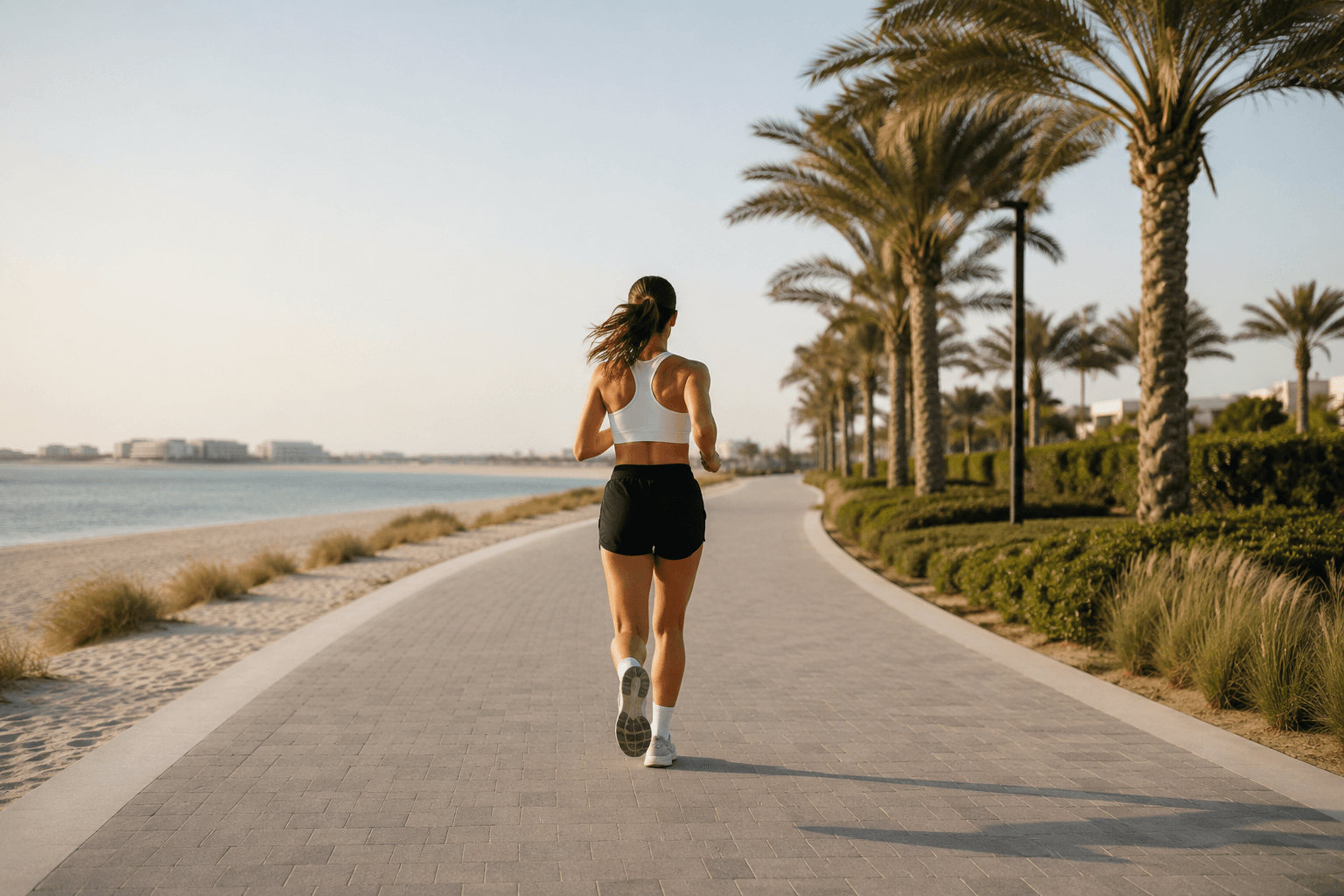
Saadiyat has some of the most pleasant running in Abu Dhabi, with flat beachside routes that fill with runners in the cooler hours. Bare Wellness opens inside Bloom Arjaan on the island in Q3 2026, with more than sixty classes a week across mornings, evenings and weekends, so a session fits before or after a run.
The Reformer Studio holds ten reformers, so the instructor can see every hip and every landing pattern in the room. If you would rather work on a specific issue first, a stride that pulls to one side, a race you are building toward, private sessions are arranged on enquiry. Grip socks are required for reformer and mat classes.
— Good to know
Frequently asked
- Is Pilates good for runners?
- Yes. It builds hip strength, single leg stability and trunk control, the qualities that keep a stride efficient as fatigue builds. Because classes are low impact, they add strength work without adding mileage stress, which is why many distance runners train it alongside their running.
- How often should a runner do Pilates?
- One to two classes a week suits most training plans. Runners in a heavy mileage block often hold at one and treat it as quality movement work, while the off season is a good time to build to two or three and address weaknesses properly.
- Should I do Pilates before or after a run?
- Either works. A short, gentle session before a run can wake up the hips and core. Fuller classes sit better after a run or on a separate day, since deep stabilizer fatigue right before speed work can make the run feel flat.
- Can Pilates help with running injuries?
- It can support recovery by strengthening the hips and core and improving control, and many runners use it while returning to mileage. It does not treat or cure injuries. If you are injured or in pain, speak to your doctor or physiotherapist first, then tell the studio so instructors can offer modifications.
- Is reformer or mat Pilates better for runners?
- Both earn their place. The reformer's springs load single leg and hip work in ways that transfer directly to running, while mat classes build trunk control you can keep up anywhere. Many runners alternate the two across the week.
- Will Pilates make me a faster runner?
- Not directly, speed still comes from run training. What Pilates changes is how much of your effort turns into forward motion: steadier hips, less wasted rotation and posture that holds late in a race. Many runners find pace comes easier at the same effort.
— Keep reading
— Saadiyat Island, Abu Dhabi
Begin your Bare ritual.
We open in Q3 2026. Leave your details and be the first to know when founding memberships and the schedule go live.